Nag Tibba Trek

Garhwal Himalayas, Uttarakhand

A quick Himalayan weekend climb through oak forests to a 3,022 m summit with sweeping Garhwal views.

Altitude

9915 ft

Duration

2 Days

Difficulty

Easy to Moderate

Best time

Mar – Jun Oct – Dec

Standout Experiences

  • Reach a real Himalayan summit at 3,022 m in just two trekking days.
  • Watch sunrise over Bandarpoonch, Swargarohini, Kala Nag and the Gangotri range from the summit ridge.
  • Experience snow in winter without committing to a long high-altitude expedition.
  • Walk through peaceful oak and rhododendron forests before camping under star-filled Himalayan skies.

Overview

Updated 10 Aug 2026

  • The Nag Tibba Trek is one of the few Himalayan summit treks you can comfortably finish over a weekend without feeling rushed. Starting from Pantwari village, the trail climbs through oak and rhododendron forests, open clearings, shepherd huts, and peaceful camps before reaching the 3,022 m summit. For trekkers coming from Delhi, Dehradun, or Mussoorie, it offers a genuine Himalayan experience without needing a long expedition.
  • The final climb to Nag Tibba Top feels far bigger than its altitude suggests. A small temple dedicated to Nag Devta sits just below the summit, and once you step onto the ridge, the horizon opens to Bandarpoonch, Swargarohini, Kala Nag, Srikanth, Gangotri peaks, Kedarnath range, and on exceptionally clear days even Nanda Devi. Sunrise from the summit is the moment most trekkers remember long after the trek ends.
  • Nag Tibba changes its personality with every season. Spring covers the forest with fresh leaves and blooming rhododendrons, summer brings cool mountain weather, autumn offers crystal-clear Himalayan views, and winter transforms the trail into one of the easiest snow treks in Uttarakhand. Even first-time trekkers get a chance to experience camping, forest trails, and a real Himalayan summit.
  • Because the trail is well-marked and the altitude stays below 3,100 m, the Nag Tibba Trek is often recommended as a first Himalayan trek. Families, solo travelers, photographers, and experienced trekkers looking for a refreshing weekend escape all find something to enjoy here. It is one of those rare trails where the journey through the forest is just as memorable as standing on the summit.

Trek essentials

Max altitude

9,915 ft

Duration

2 Days

Total distance

16 km

Elevation gain

3,937 ft

Trek type

Out and Back

Starting point

Pantwari Village

Trail type

Forest trail with meadows and ridge walk

Average cost (indicative)

₹2,000–₹4,500 per person (shared package); ₹500–₹1,000 DIY excluding transport

Temp. range (°C)

-5°C to 22°C depending on season

Snow months

December to February

Rain risk

High during July–August monsoon

Nearest Railway Station

Dehradun

Nearest Airport

Jolly Grant Airport, Dehradun

Best Season

September–March for clear views; December–February for snow

Mobile Network

Works at Pantwari; patchy after leaving the village
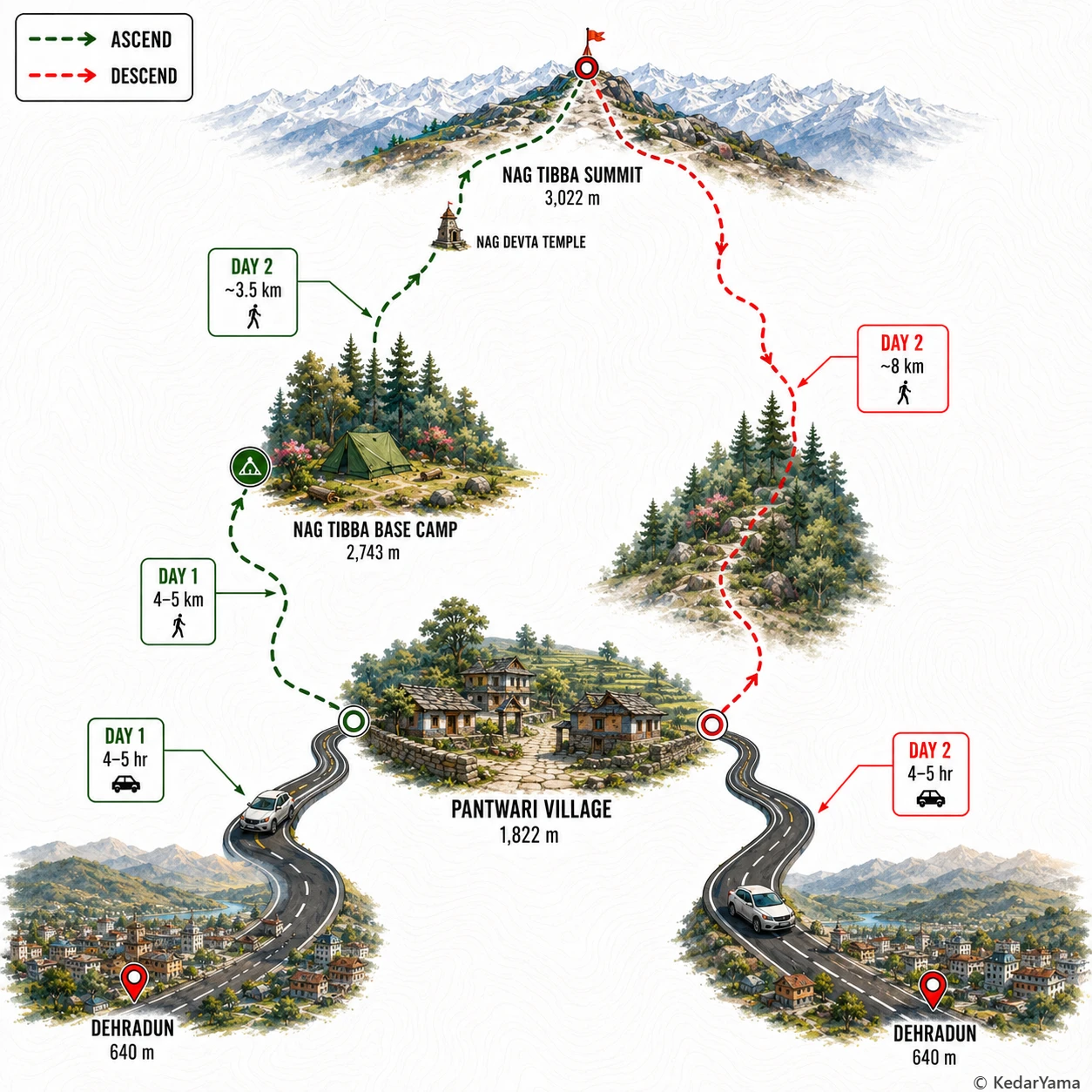
Trek Route

Graphical route map — high resolution terrain visualization

Detailed Itinerary

campingStayTent
signal_cellular_altDataPartial
power_offPowerNot available
  • Meet in Dehradun around 6:00 AM and drive for 4–5 hours through Mussoorie Road, passing small Garhwali villages before reaching Pantwari around late morning for breakfast and the trek briefing.
  • Start trekking by 11:00 AM. The first section climbs gradually on a stone-paved village path before entering cool oak and rhododendron forest where birdsong replaces road noise.
  • The 4–5 km climb takes about 4–5 hours with steady ascents, short rest stops and occasional openings that reveal the Doon Valley and surrounding ridges.
  • By late afternoon the forest opens into grassy clearings around Nag Tibba Base Camp. Settle into tents, enjoy hot snacks while watching sunset colours over the Garhwal hills, and spend the night under a star-filled Himalayan sky.

Packing List

Must Have

Trekking Boots

layers

3-Layer Clothes

backpack

50L Backpack

water_drop

Hydration

ac_unit

Down Jacket

back_hand

Gloves

Woolen Socks

Woolen Socks

lightbulb

Headlamp

thermostat

Thermal Layers

medical_services

First Aid Kit

Good to Have

timeline

Trekking Pole

battery_charging_full

Power Bank

photo_camera

Action Cam

checkroom

Quick-dry Towel

front_hand

Winter Gloves

directions_walk

Trek Gaiters

water_full

Hydration Bladder

Technical Overview

terrain

Trail & Terrain

The Nag Tibba trail begins on village paths before entering dense oak, rhododendron and deodar forests. Most of the route follows a broad dirt track with occasional rocky stretches and a few steeper switchbacks. Near the summit, the gradient increases noticeably and can become snowy or icy in winter. The trail remains easy to follow throughout the year.

ac_unit

Weather Through the Seasons

Spring brings blooming rhododendrons and pleasant daytime temperatures, while autumn offers crystal-clear mountain views after the monsoon. Winters are cold with frequent snowfall from December through February, turning the trail into an excellent beginner snow trek. The monsoon months receive heavy rain, making the trail muddy and slippery.

info

Altitude & Fitness

At 3,022 metres, Nag Tibba is high enough to provide a true Himalayan experience but low enough that altitude sickness is uncommon for most trekkers. The biggest challenge is the sustained climb from Pantwari and the steep final push to the summit. Anyone comfortable walking 5–6 hours with a daypack and climbing stairs regularly should manage the trek well.

info

Forest & Wildlife

The lower slopes are covered with thick oak, deodar and rhododendron forests that remain cool even during summer. In spring, the hillsides turn bright red with rhododendron blossoms, while birds such as the Himalayan monal, woodpeckers and laughing thrushes are commonly spotted. Langurs and barking deer are occasionally seen in quieter sections of the forest.

When to Visit

local_florist

Fresh Forests & Clear Views

March – April

Oak and rhododendron forests become fresh and colorful after winter. Days stay pleasant for trekking, while mornings and evenings remain cool with excellent mountain visibility.

calendar_today

Cool Weekend Escape

May – June

Warm days and comfortable nights make this a popular season for families and first-time trekkers. The forests provide plenty of shade, making the climb enjoyable even before the monsoon.

calendar_today

Best Himalayan Panoramas

October – November

After the monsoon, the air turns exceptionally clear and the Himalayan ranges look their sharpest. Dry trails and stable weather make this one of the best trekking seasons.

ac_unit

Snowy Summit Adventure

December – February

Fresh snowfall often covers the upper trail and summit, creating one of Uttarakhand's easiest snow trekking experiences. Temperatures drop below freezing at night, so proper winter clothing is essential.

Other Information

Logistics & inclusions

  • check_circleReach Dehradun by train, flight or overnight bus, then hire a shared taxi or private cab to Pantwari (around 4–5 hours).
  • check_circleMost trek operators start after breakfast from Pantwari and provide camping equipment and meals.
  • check_circleExtra luggage can usually be left safely at the guesthouse or operator's vehicle in Pantwari.
  • check_circleCarry sufficient cash before reaching Pantwari as ATMs are limited in the hills.
  • check_circleMobile connectivity is available in Pantwari but becomes weak or unavailable beyond the village.

Permits

Required: No

No special trekking permit is normally required for Indian trekkers on the standard Nag Tibba route. Trek operators may collect nominal camping or forest entry charges where applicable.

Safety

Risks

  • Slippery rocks and muddy sections during monsoon.
  • Snow and ice near the summit during winter mornings.
  • Rapid weather changes with strong winds on the ridge.
  • Limited mobile network after leaving Pantwari.

Precautions

  • Start early to avoid afternoon clouds and return before dark.
  • Carry at least 2 litres of water and warm layers even in summer.
  • Use trekking poles or microspikes when snow or ice is present.
  • Stay on the marked trail and avoid shortcuts through the forest.

Emergency

The nearest medical facilities are in Nainbagh and Dehradun. Local guides and villagers from Pantwari are the primary source of assistance on the trail. Inform your family and trek leader before starting as network coverage is intermittent.

Reviews

Frequently Asked Questions

Is the Nag Tibba Trek suitable for beginners?expand_more
What is the best time to do the Nag Tibba Trek?expand_more
Does Nag Tibba have snow in December and January?expand_more
How do I reach Nag Tibba Trek from Delhi?expand_more
Do I need a permit for the Nag Tibba Trek?expand_more
How difficult is the summit climb?expand_more
Nag Tibba Trek or Kedarkantha Trek: which is better for beginners?expand_more