Nafran Valley Trek

Kashmir Himalayas, Jammu and Kashmir

A remote Kashmir trek through pine forests, twin alpine lakes and the dramatic Nafran Valley to Harnag Pass.

Altitude

14127 ft

Duration

7 Days

Difficulty

Moderate to Hard

Best time

Jul – Sep

Standout Experiences

  • Cross Harnag Pass and watch two completely different Kashmir landscapes unfold on either side.
  • Camp beside the twin alpine lakes of Harnag and Harbhagwan, surrounded by rugged mountain walls.
  • Walk through remote shepherd meadows where Gujjar and Bakarwal families still spend their summers.
  • Experience one of Kashmir's least-crowded high-altitude treks without sacrificing dramatic scenery.

Overview

Updated 11 Aug 2026

  • The Nafran Valley Trek feels like the quieter side of Kashmir, far away from the crowds that gather on the better-known trails. Starting from Aru near Pahalgam, the route climbs through dense pine forests, open shepherd meadows and flower-filled grasslands before reaching the wide alpine basin of Nafran Valley. Every day brings a different landscape, making the journey feel fresh from start to finish.
  • The biggest highlight comes as you cross Harnag Pass at over 4,100 metres. From the top, you can look back across the untouched Nafran Valley and ahead towards the famous Kashmir Great Lakes region. Along the way, you'll camp beside the turquoise waters of Harnag Lake and Harbhagwan Lake, where early mornings are often calm enough to mirror the surrounding peaks.
  • Unlike many Himalayan treks that focus on a single summit or lake, the Nafran Valley Trek combines forests, rolling meadows, glacial streams, high-altitude lakes and a challenging mountain pass into one complete adventure. July brings lingering snow around the lakes, August paints the valley with wildflowers, and early September adds golden shades to the grasslands under crystal-clear skies.
  • This is a trek for people who enjoy quieter trails and a genuine wilderness experience. You'll often meet only local shepherds moving with their flocks through the valley, while nights are spent under exceptionally dark skies with almost no signs of civilisation. The combination of solitude, varied terrain and dramatic scenery makes Nafran Valley one of Kashmir's most rewarding high-altitude treks.

Trek essentials

Max altitude

14,127 ft

Duration

7 Days

Total distance

42 km

Elevation gain

6,167 ft

Trek type

Out and Back

Starting point

Aru Village, Kashmir

Trail type

Forest, meadow, alpine valley and glacial lake trail

Average cost (indicative)

₹15,000–₹19,000 per person

Temp. range (°C)

5°C to 18°C

Snow months

Late June to early July (higher sections), October onward

Rain risk

Low to Moderate

Best Season

July to September

Nearest Airport

Srinagar International Airport

Nearest Railway Station

Jammu Tawi

Base Camp

Aru Village

Mobile Network

Available till Aru; no reliable network on trek

Accommodation

Twin-sharing alpine tents
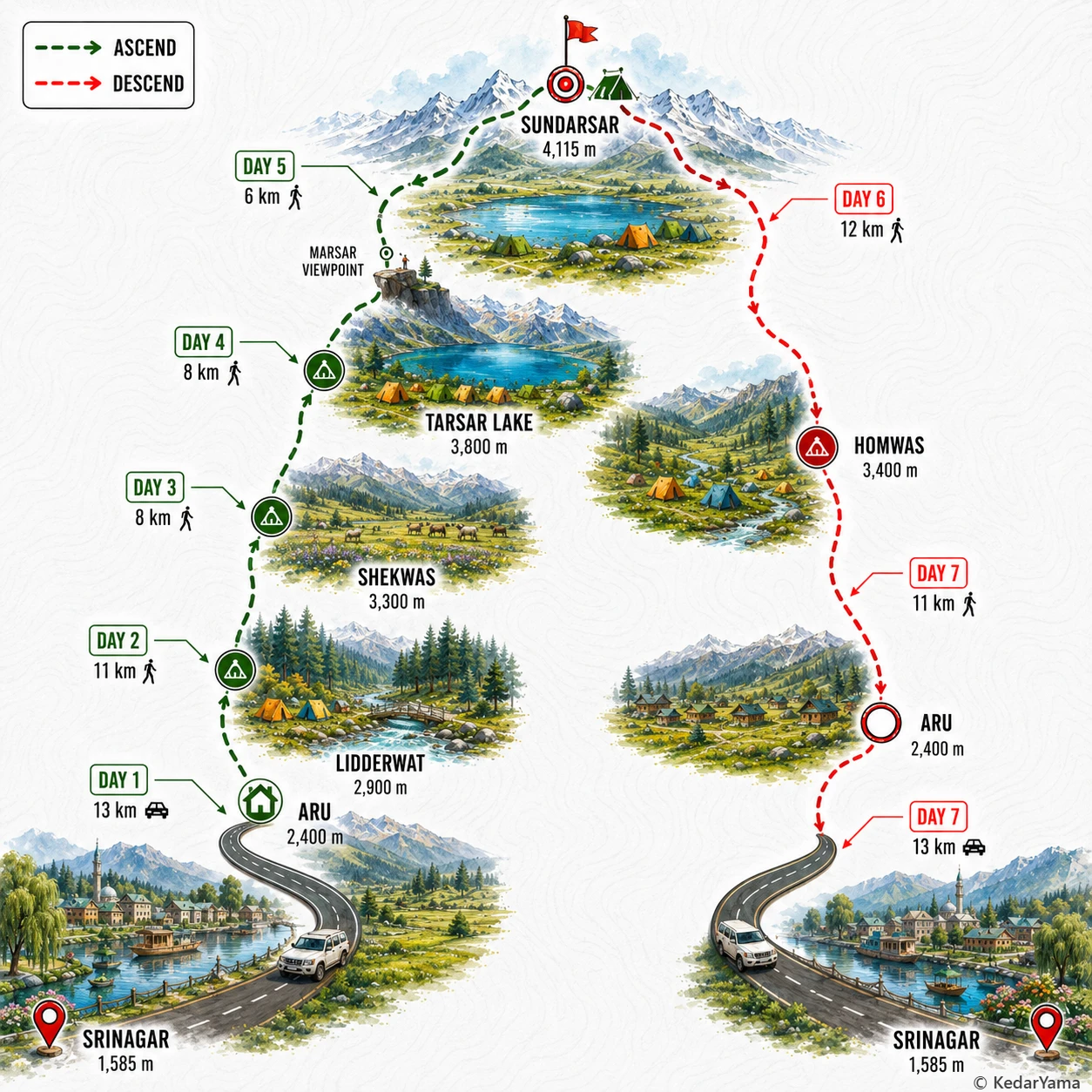
Trek Route

Graphical route map — high resolution terrain visualization

Detailed Itinerary

campingStayTent
signal_cellular_altDataPartial
boltPowerAvailable
  • Leave Srinagar around 8 AM for a beautiful 4–5 hour drive through Pampore, Anantnag and Pahalgam before reaching the quiet mountain village of Aru around lunchtime.
  • The road follows the Lidder River for much of the journey, with snow-covered peaks appearing closer as apple orchards and pine forests replace the city landscape.
  • Spend the afternoon meeting your trek leader, checking equipment and taking a short acclimatization walk around Aru before an early dinner and overnight stay.

Packing List

Must Have

Trekking Boots

layers

3-Layer Clothes

backpack

50L Backpack

water_drop

Hydration

timeline

Trekking Pole

ac_unit

Down Jacket

back_hand

Gloves

Woolen Socks

Woolen Socks

lightbulb

Headlamp

thermostat

Thermal Layers

medical_services

First Aid Kit

battery_charging_full

Power Bank

Good to Have

photo_camera

Action Cam

checkroom

Quick-dry Towel

water_full

Hydration Bladder

front_hand

Winter Gloves

directions_walk

Trek Gaiters

inventory_2

Sun Cap

inventory_2

Sunscreen

inventory_2

Lip Balm

Technical Overview

terrain

Trail & Terrain

The Nafran Valley Trek begins through thick pine forests before opening into expansive alpine meadows used by Gujjar and Bakarwal shepherds during summer. The route alternates between grassy valleys, rocky ridges, moraine sections and glacial stream crossings. The climb to Harnag Pass is the steepest section of the trek, requiring careful footing on loose rocks and snow patches early in the season.

info

Altitude & Acclimatization

The trek reaches over 14,000 feet, making altitude management essential. Camps are planned progressively higher, allowing the body to acclimatize naturally before crossing the highest point. Staying hydrated, maintaining a steady pace and reporting AMS symptoms early significantly improve safety.

ac_unit

Weather Conditions

Days are usually pleasant between 12°C and 18°C during peak season, while nights commonly fall to 5°C or lower at higher camps. Afternoon clouds and brief showers are possible even in summer, and strong winds are common around Harnag Pass. Layered clothing is essential because temperatures change rapidly with altitude.

info

Nature & Wildlife

The lower trail passes through fragrant pine forests before reaching vast flower-filled meadows in July and August. Shepherd settlements, grazing horses and sheep are common throughout the valley. Trekkers may spot Himalayan monals, marmots, musk deer and soaring golden eagles, while the surrounding peaks remain snow-clad for much of the trekking season.

When to Visit

calendar_today

Snow melting season

July

Early July still has snow near Harnag Pass and around the higher lakes. Meadows begin turning green while streams flow strongly from melting snow.

calendar_today

Wildflower season

August

Kashmir receives only light monsoon showers compared to most Himalayan regions. The valley is at its greenest, wildflowers are everywhere and daytime trekking conditions are usually pleasant.

calendar_today

Clear mountain views

Early September

The skies become clearer, the meadows slowly turn golden and mountain views are exceptionally sharp. Nights become colder, but this is one of the best times for photography.

Other Information

Logistics & inclusions

  • check_circleArrive in Srinagar a day before the trek begins.
  • check_circleDrive around 112 km (4–5 hours) from Srinagar to Aru Village via Pahalgam.
  • check_circleMost operators provide pickup and drop from Srinagar.
  • check_circleKeep duffel bags under operator weight limits, usually around 10 kg.
  • check_circleCarry a daypack with water, snacks and rain protection during trekking days.
  • check_circleNo electricity or reliable mobile network is available after Aru.

Permits

Required: Yes

Forest permissions and local trekking registrations are arranged by registered trek operators. Carry original government photo ID and passport-sized photographs. Foreign nationals may require additional identification verification.

Safety

Risks

  • Acute Mountain Sickness above 3,500 m
  • Rapid weather changes
  • Cold nights and wind chill
  • Slippery stream crossings
  • Loose scree near Harnag Pass

Precautions

  • Follow acclimatization schedule and maintain hydration.
  • Walk at a steady pace without racing uphill.
  • Carry rain gear and warm layers every day.
  • Cross streams only under guide supervision.
  • Report headache, nausea or unusual fatigue immediately.

Emergency

Nearest medical facilities are at Pahalgam and Srinagar. Rescue options are limited inside the valley, so evacuation usually involves returning on foot to Aru before road transport.

Reviews

Frequently Asked Questions

What is the best time to do the Nafran Valley Trek?expand_more
Is the Nafran Valley Trek difficult for beginners?expand_more
How do I reach the Nafran Valley Trek starting point?expand_more
Can I see snow on the Nafran Valley Trek?expand_more
Do I need permits for the Nafran Valley Trek?expand_more
How much does the Nafran Valley Trek usually cost?expand_more
Nafran Valley Trek or Kashmir Great Lakes Trek – which should I choose?expand_more