Kashmir Great Lakes Trek

Kashmir Himalayas, Jammu and Kashmir

Seven alpine lakes, flower-filled meadows, and high mountain passes across Kashmir's most iconic summer trail.

Altitude

13780 ft

Duration

8 Days

Difficulty

Moderate to Hard

Best time

Jul – Sep

Standout Experiences

  • Walk past six to seven stunning alpine lakes instead of hiking to just one destination.
  • Cross Gadsar Pass and watch the landscape transform from lush green meadows to rugged mountain valleys in a single day.
  • Camp beside Gangbal and Nundkol with the massive Harmukh peak rising directly above the lakes.
  • Experience Kashmir at its summer best, with wildflower-filled meadows in July and August and golden valleys in early September.

Overview

Updated 10 Aug 2026

  • The Kashmir Great Lakes Trek is the trek people picture when they dream about trekking in Kashmir. Starting from Sonamarg and ending at Naranag, the trail crosses rolling grasslands, maple and birch forests, three high-altitude passes, and a chain of glacial lakes that seem to change colour with every shift in the sky. Vishansar, Kishansar, Gadsar, Satsar, Gangbal, and Nundkol each have their own character, making every day feel completely different from the last.
  • What makes this trek unforgettable is how quickly the landscape changes. One morning you're climbing through wildflower-covered meadows with shepherds grazing their flocks, and by afternoon you're standing above turquoise lakes surrounded by rugged peaks. The highest point, Gadsar Pass at around 4,200 m, opens up a sweeping panorama before the trail drops into another valley dotted with alpine streams and grazing horses.
  • Unlike many Himalayan treks that build toward a single summit, the Kashmir Great Lakes Trek rewards you every single day. The camps beside Vishansar, Satsar, and Gangbal are destinations in themselves, especially during July and August when the meadows are bright green and filled with blooming alpine flowers. By early September, the crowds thin out, the grass turns golden, and the lakes reflect crystal-clear skies.
  • This is a moderate to difficult trek best suited for trekkers with good fitness and some prior hiking experience. Long walking days, multiple pass crossings, and high altitude make it physically demanding, but the rewards are exceptional. If you're looking for one trek that captures the very best of Kashmir's landscapes in a single journey, this is the one most experienced trekkers recommend.

Trek essentials

Max altitude

13,780 ft

Duration

8 Days

Total distance

74 km

Elevation gain

7,874 ft

Trek type

Point-to-point

Starting point

Sonamarg (Shitkadi)

Trail type

Alpine meadows, mountain passes, glacial lakes, rocky trails

Average cost (indicative)

₹16,000–₹25,000 per person

Temp. range (°C)

-2°C to 22°C

Snow months

October to June

Rain risk

Moderate during July and August due to western disturbances and occasional monsoon influence

Best Season

Late June to early September

Exit Point

Naranag

Highest Pass

Gadsar Pass (4,200 m)

Mobile Network

Available only around Sonamarg and Naranag; no reliable network on trek
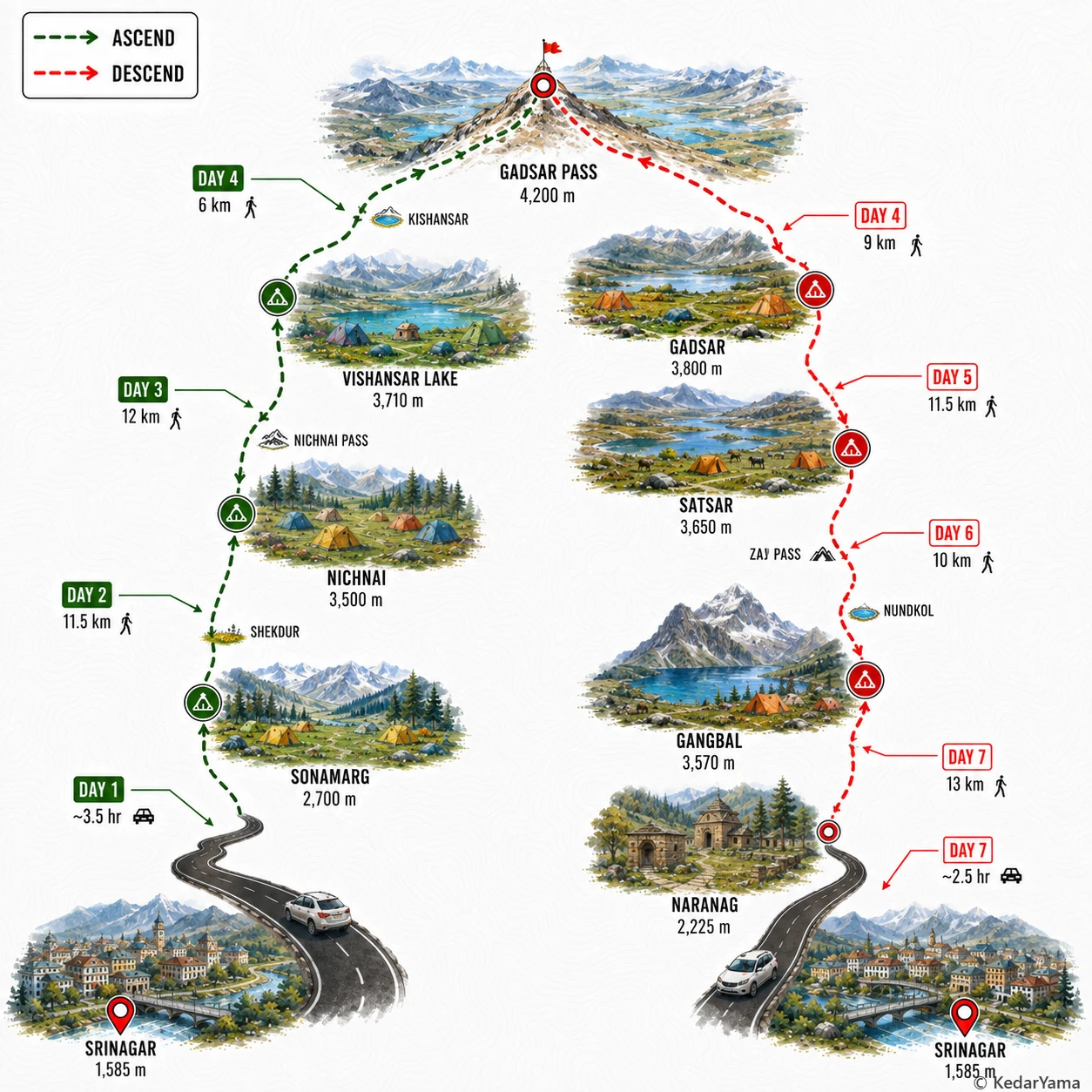
Trek Route

Graphical route map — high resolution terrain visualization

Detailed Itinerary

campingStayTent
signal_cellular_4_barDataFull
boltPowerAvailable
  • Reach Srinagar by late morning and begin the 3–4 hour drive to Sonamarg, following the Sindh River through Ganderbal, Kangan and mountain villages.
  • Expect to arrive at base camp by late afternoon, settle into tents, complete registration and attend a detailed trek briefing before dinner.
  • Spend the evening checking gear, hydrating well and enjoying your first views of snow-covered peaks surrounding the Sonamarg valley.

Packing List

Must Have

Trekking Boots

layers

3-Layer Clothes

backpack

50L Backpack

water_drop

Hydration

timeline

Trekking Pole

ac_unit

Down Jacket

thermostat

Thermal Layers

back_hand

Gloves

Woolen Socks

Woolen Socks

lightbulb

Headlamp

medical_services

First Aid Kit

battery_charging_full

Power Bank

Good to Have

photo_camera

Action Cam

checkroom

Quick-dry Towel

water_full

Hydration Bladder

directions_walk

Trek Gaiters

front_hand

Winter Gloves

Technical Overview

terrain

Long alpine walking days

The Kashmir Great Lakes Trek is defined by long days of walking across rolling alpine meadows, glacial valleys, moraine fields and rocky mountain passes. Most days involve 6 to 8 hours on the trail with several sustained climbs above 4,000 metres. The descents can be steep and slippery after rain, making trekking poles highly recommended.

info

High-altitude acclimatization

The trek begins around 2,700 metres and quickly climbs beyond 3,500 metres on the second trekking day. Gadsar Pass is the highest point at roughly 4,200 metres, where reduced oxygen can cause Acute Mountain Sickness if trekkers ascend too quickly. Proper hydration, gradual pacing and reporting symptoms early are essential.

ac_unit

Rapid mountain weather changes

Morning skies are usually clear, while afternoons often bring clouds, light rain or hail. Camps experience cold nights close to freezing even in peak summer. Strong winds become common on exposed passes, so waterproof layers and warm insulation should remain accessible throughout the trek.

info

Meadows, flowers and wildlife

The trail passes through maple, pine, silver birch and bhoj forests before opening into expansive alpine grasslands. During July and August the meadows bloom with wildflowers including blue poppies, daisies and buttercups. Himalayan marmots, monals, Himalayan griffons and occasional musk deer may be spotted away from camps.

When to Visit

calendar_today

Wildflowers and Emerald Meadows

July – August

This is when the trail is at its most colourful. Snow has mostly melted, alpine flowers cover the meadows, and every lake shines in shades of blue and turquoise. Expect the highest number of trekkers during this period.

calendar_today

Golden Valleys and Clear Skies

Early September

The meadows slowly turn golden, the air becomes crisper, and mountain views are often at their clearest. Crowds begin to reduce, making this a favourite time for photographers.

Other Information

Logistics & inclusions

  • check_circleMost groups assemble in Srinagar before driving 3–4 hours to Sonamarg (Shitkadi) for the trek start.
  • check_circleThe trek ends at Naranag, followed by a 2–3 hour drive back to Srinagar.
  • check_circleExtra luggage can usually be stored with the trek operator at the base camp or Srinagar hotel.
  • check_circleGovernment registration and identity verification are completed at army checkpoints along the route.
  • check_circlePonies are available only on certain sections and should not be relied upon for the complete trek.

Permits

Required: Yes

Forest permissions and local administration registration are mandatory and are generally arranged by registered trek operators. Carry a government-issued photo ID for army checkpoints and permit verification.

Safety

Risks

  • Acute Mountain Sickness above 3,500 m
  • Rapid weather changes including rain, hail and strong winds
  • Slippery rocks and steep descents near mountain passes
  • Cold nights with temperatures around or below freezing
  • Remote terrain with limited evacuation options

Precautions

  • Maintain a slow pace and stay well hydrated.
  • Carry waterproof clothing and warm layers every day.
  • Never trek ahead of the guide in fog or poor visibility.
  • Use trekking poles during steep descents.
  • Inform trek leaders immediately if experiencing headache, nausea or breathlessness.

Emergency

Army posts are present at a few locations including the Gadsar sector, but medical facilities are extremely limited. The nearest major medical assistance is available after exiting at Naranag or returning to Srinagar.

Reviews

Frequently Asked Questions

Is the Kashmir Great Lakes Trek suitable for beginners?expand_more
What is the best time to do the Kashmir Great Lakes Trek?expand_more
How do I reach the Kashmir Great Lakes Trek from Delhi?expand_more
Will I see snow on the Kashmir Great Lakes Trek?expand_more
Do I need permits for the Kashmir Great Lakes Trek?expand_more
How difficult is the altitude on the Kashmir Great Lakes Trek?expand_more
How much does the Kashmir Great Lakes Trek usually cost?expand_more
Kashmir Great Lakes Trek vs Tarsar Marsar Trek – which one should I choose?expand_more