Har Ki Dun Trek

Garhwal Himalayas, Govind Wildlife Sanctuary, Uttarakhand

Walk through ancient Osla village to a wide Himalayan valley beneath the legendary Swargarohini peaks.

Altitude

12720 ft

Duration

7 Days

Difficulty

Moderate

Best time

Mar – Jun Sep – Nov

Standout Experiences

  • Walk through the ancient village of Osla, where traditional wooden houses and temples make it feel like time has slowed down.
  • Reach the wide Har Ki Dun valley with the towering Swargarohini peaks filling the horizon instead of a single summit viewpoint.
  • Follow rivers, wooden bridges, forests, meadows, and glaciers on one trek instead of seeing just one type of landscape.
  • Experience one of Uttarakhand's most culturally rich Himalayan trails, where local legends connect the valley to the Pandavas' final journey.

Overview

Updated 10 Aug 2026

  • The Har Ki Dun Trek is one of Uttarakhand's most rewarding valley treks because every day feels different. The trail follows the Supin and Thamsa rivers through dense pine forests, wooden bridges, old shepherd settlements, and the centuries-old village of Osla before opening into the broad Har Ki Dun valley at around 3,540 m (11,600 ft). Standing below the Swargarohini massif, you understand why locals connect this landscape with stories from the Mahabharata.
  • Unlike many Himalayan treks that focus only on reaching a summit, Har Ki Dun is about slowing down and experiencing mountain life. You'll pass traditional wooden homes built in the distinctive architecture of the region, meet villagers who still follow age-old customs, and walk through meadows where shepherds graze their flocks during summer. The mix of culture, forests, rivers, and dramatic mountain views makes this trek feel richer than a typical high-altitude hike.
  • Spring transforms the valley with blooming wildflowers, fresh greenery, and comfortable trekking weather from March to June. After the monsoon, September to November brings crystal-clear mountain views, golden forests, crisp air, and some of the best photography conditions in the Garhwal Himalayas. Both seasons offer completely different experiences, making Har Ki Dun worth visiting more than once.

Trek essentials

Max altitude

12,720 ft

Duration

7 Days

Total distance

44 km

Elevation gain

4,200 ft

Trek type

Out and Back

Starting point

Taluka

Trail type

Forest, village and alpine valley trail

Average cost (indicative)

₹10,000–₹16,000 per person

Temp. range (°C)

-5°C to 20°C

Snow months

December to March

Rain risk

High during July to early September

Nearest Base Camp

Sankri

Nearest Railway Station

Dehradun

Nearest Airport

Jolly Grant Airport, Dehradun

Network

Limited at Sankri, almost none after Taluka

Best Season

April–June and September–November
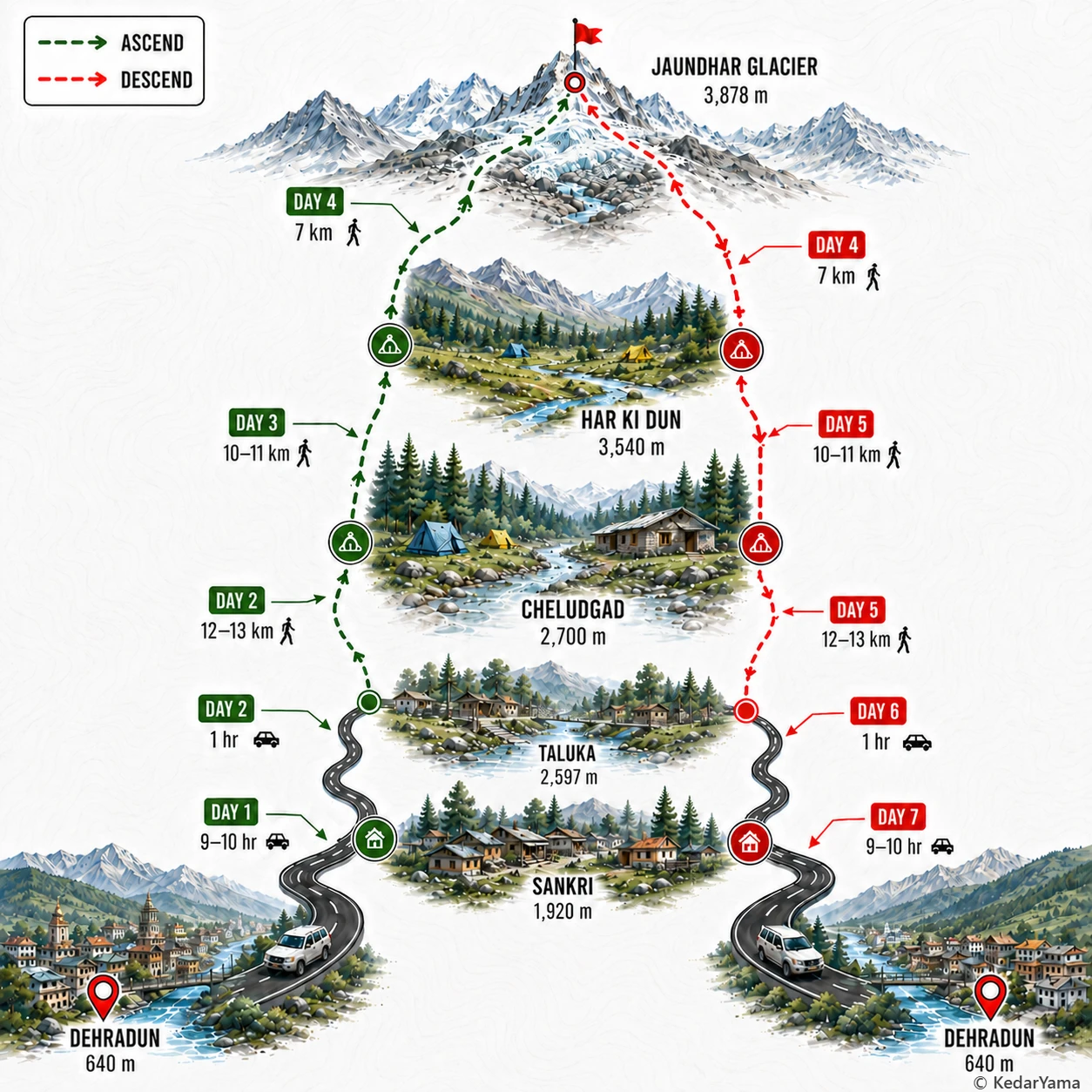
Trek Route

Graphical route map — high resolution terrain visualization

Detailed Itinerary

holiday_villageStayHomestay
signal_cellular_altDataPartial
boltPowerAvailable
  • Meet in Dehradun around 6:00 AM and begin the 9–10 hour drive into the Garhwal Himalayas, reaching Sankri by evening.
  • The road follows the Yamuna and later the Tons River, passing Mussoorie, Naugaon, Purola, Mori and the forested valleys of the Govind Wildlife Sanctuary.
  • Stop for breakfast and lunch at roadside dhabas before the winding mountain road climbs steadily to Sankri.
  • Reach the quiet mountain village around 5:00–6:00 PM, complete trek briefing, check equipment and enjoy your first clear views of Swargarohini if the weather is good.

Packing List

Must Have

Trekking Boots

backpack

50L Backpack

layers

3-Layer Clothes

water_drop

Hydration

timeline

Trekking Pole

ac_unit

Down Jacket

thermostat

Thermal Layers

back_hand

Gloves

Woolen Socks

Woolen Socks

lightbulb

Headlamp

medical_services

First Aid Kit

battery_charging_full

Power Bank

Good to Have

photo_camera

Action Cam

checkroom

Quick-dry Towel

water_full

Hydration Bladder

front_hand

Winter Gloves

directions_walk

Trek Gaiters

inventory_2

Sun Cap

inventory_2

Rain Cover

inventory_2

Sunglasses

Technical Overview

terrain

Trail and Terrain

Har Ki Dun follows one of the oldest trade routes in the Garhwal Himalayas. The trail stays below the tree line for much of the journey, passing through dense pine, deodar, walnut and oak forests before opening into wide alpine meadows. Most of the route follows the Supin River with several wooden bridges, gradual climbs and occasional rocky sections. It is a comfortable trekking trail but the long walking days demand steady endurance.

info

Altitude and Acclimatization

Although the highest point is around 11,700 ft, the altitude gain is gradual, making Har Ki Dun one of the better Himalayan treks for first-time high-altitude trekkers. Spending a night at Sankri before starting helps with acclimatization. Stay hydrated, maintain a slow pace and avoid rushing on the ascent. Mild altitude symptoms can still occur above Seema.

ac_unit

Weather Conditions

Spring brings pleasant daytime temperatures with cool nights and blooming rhododendrons. Autumn offers crisp weather, clear mountain views and cold mornings. Winter transforms the valley into a snow-covered landscape with sub-zero nights, while the monsoon makes the trail slippery because of heavy rainfall and swollen streams.

info

Wildlife and Forests

The trek passes through Govind Wildlife Sanctuary, known for rich Himalayan biodiversity. Trekkers frequently see Himalayan langurs, mountain goats and numerous bird species including the Himalayan monal. Dense conifer forests gradually give way to open bugyals where colorful alpine flowers bloom during late spring and early summer.

When to Visit

local_florist

Flowers, fresh forests and comfortable trekking

March – June

Snow patches remain in early spring before the forests turn lush green with blooming wildflowers. Days are pleasant, making this the most popular season for first-time trekkers.

calendar_today

Crystal-clear mountain views

September – November

After the monsoon, the air becomes clear and the valley glows with green and golden shades. Cool temperatures and excellent visibility make this the favorite season for photographers.

Other Information

Logistics & inclusions

  • check_circleReach Dehradun a day before departure for the drive to Sankri.
  • check_circleDrive from Dehradun to Sankri takes around 9–10 hours.
  • check_circleA shared jeep takes trekkers from Sankri to Taluka in about 1 hour.
  • check_circleKeep extra luggage at the Sankri guesthouse if returning by the same route.
  • check_circleForest entry and Govind Wildlife Sanctuary permits are arranged before entering the trail.
  • check_circleThere are no ATMs after Mori, so carry sufficient cash.

Permits

Required: Yes

Entry permit for Govind Pashu Vihar National Park and Wildlife Sanctuary is mandatory. Indian and foreign nationals pay different conservation fees. Trek operators generally arrange the permit after collecting valid government ID.

Safety

Risks

  • Altitude sickness above 10000 ft
  • Slippery rocks and muddy sections after rain
  • Cold nights during spring, autumn and winter
  • River crossings may become difficult during monsoon

Precautions

  • Acclimatize properly at Sankri before starting the trek.
  • Drink plenty of water and maintain a slow walking pace.
  • Carry waterproof layers and warm clothing even in summer.
  • Avoid trekking during heavy rainfall due to landslide risk.
  • Stay with the group inside the wildlife sanctuary.

Emergency

The nearest medical facilities are at Mori and Purola, while Sankri has basic first aid support. Mobile connectivity is generally available only up to Sankri with occasional signal at Osla depending on the network.

Reviews

Frequently Asked Questions

Is Har Ki Dun Trek suitable for beginners?expand_more
What is the best time to visit Har Ki Dun Trek?expand_more
Does Har Ki Dun Trek have snow in December?expand_more
How do I reach Har Ki Dun Trek from Delhi?expand_more
Do I need a permit for Har Ki Dun Trek?expand_more
How difficult is Har Ki Dun Trek compared to Kedarkantha?expand_more
What are the main highlights of Har Ki Dun Trek?expand_more