Ghepan Lake Trek

Lahaul Valley, Pir Panjal Himalaya, Himachal Pradesh

A wild Lahaul trek to a glowing turquoise glacial lake beneath hanging glaciers and rugged Himalayan ridges.

Altitude

14131 ft

Duration

5 Days

Difficulty

Moderate

Best time

Jun – Jul Aug – Oct

Standout Experiences

  • Reach one of Himachal Pradesh's most striking turquoise glacial lakes without trekking through crowded trails.
  • Walk beneath hanging glaciers and across rugged moraine terrain that feels far more remote than most weekend Himalayan treks.
  • Experience the quiet side of Lahaul, where you may meet more shepherds than fellow trekkers.
  • Watch the lake change from deep blue to emerald as sunlight moves across the surrounding glaciers.

Overview

Updated 10 Aug 2026

  • The Ghepan Lake Trek is one of Lahaul's best-kept secrets. Starting near Sissu on the Manali–Leh highway, the trail leaves the busy road behind almost immediately and enters a quiet valley where you'll hear rushing glacial streams far more often than other trekkers. The route passes shepherd camps, alpine meadows, loose moraines, and dramatic ridgelines before revealing the lake in an unforgettable burst of turquoise surrounded by snow and hanging glaciers.
  • Unlike many popular Himalayan treks, Ghepan Lake still feels genuinely wild. There are no permanent tea houses or crowded campsites, and sections of the trail are faint enough that most trekkers hire a local guide. The reward is a landscape that changes every hour—green valley floors, rocky glacier terrain, wildflowers through summer, and finally the icy blue lake sitting beneath the towering Ghepan Glacier.
  • The final approach is what makes this trek memorable. After climbing across rocky slopes and glacial debris, the valley suddenly opens to reveal a brilliantly coloured alpine lake framed by snowfields and sharp peaks. On clear mornings, the reflections in the water are so vivid that the lake almost looks unreal, making the long climb feel completely worthwhile.

Trek essentials

Max altitude

14,131 ft

Duration

5 Days

Total distance

25 km

Elevation gain

3,898 ft

Trek type

Out and Back

Starting point

Tori Village (via Sissu, Lahaul)

Trail type

Alpine valley trail

Average cost (indicative)

₹12,000–18,000 per person (excluding travel to Manali)

Temp. range (°C)

5°C to 20°C (Jun–Sep)

Snow months

Late May to June

Rain risk

Low to Moderate (monsoon showers and stream swelling possible)

Best Season

Mid-June to September

Nearest Town

Sissu, Lahaul

Nearest Airport

Bhuntar (Kullu)
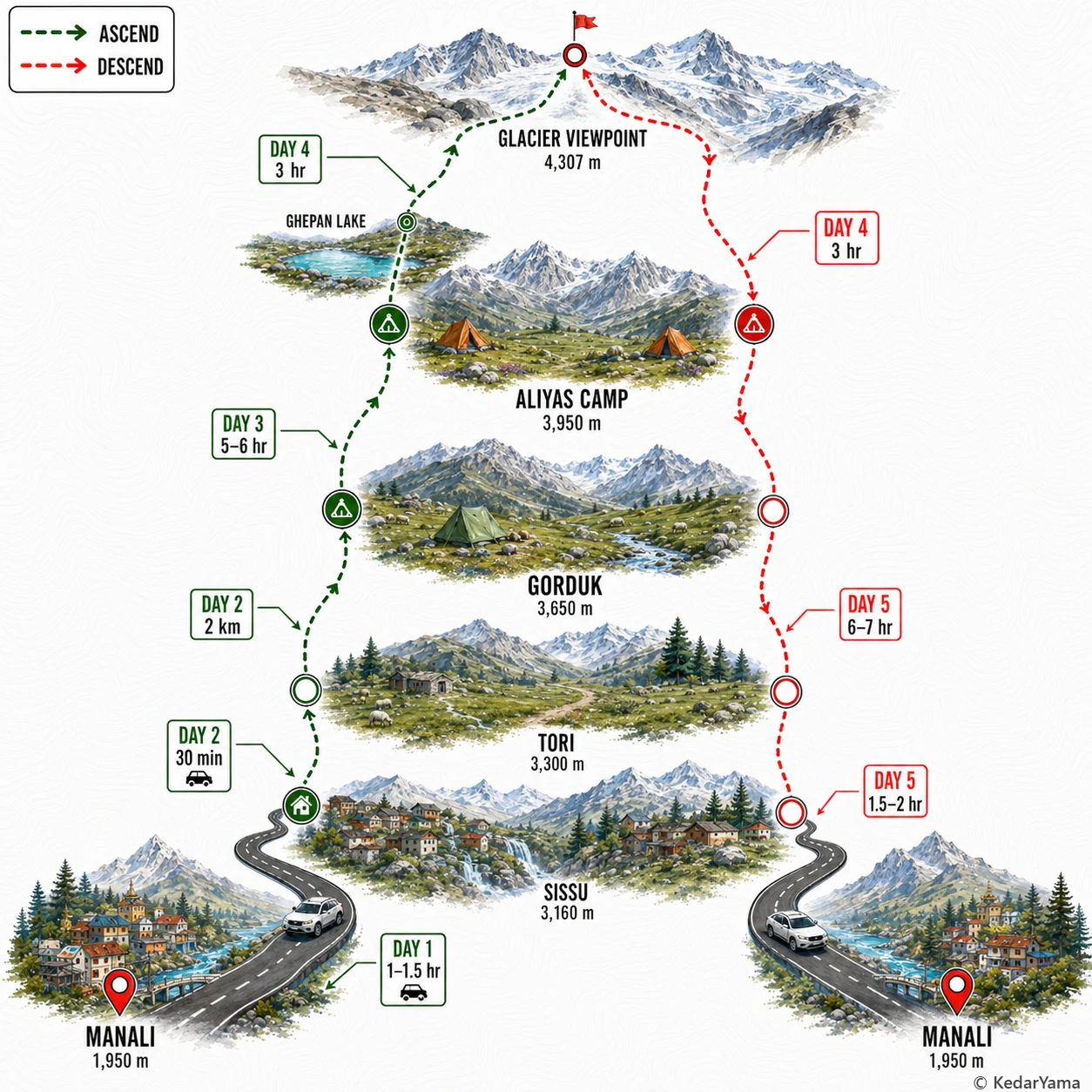
Trek Route

Graphical route map — high resolution terrain visualization

Detailed Itinerary

holiday_villageStayHomestay
signal_cellular_4_barDataFull
boltPowerAvailable
  • Report in Manali around late morning and drive for about 1–1.5 hours through the Atal Tunnel to Sissu, reaching by afternoon.
  • The landscape changes dramatically after the tunnel as lush Kullu gives way to the dry mountains of Lahaul, with waterfalls tumbling beside the highway.
  • Spend the evening checking gear, taking a short acclimatization walk around Sissu and resting well before the trek begins the next morning.

Packing List

Must Have

Trekking Boots

layers

3-Layer Clothes

backpack

50L Backpack

water_drop

Hydration

timeline

Trekking Pole

ac_unit

Down Jacket

back_hand

Gloves

Woolen Socks

Woolen Socks

lightbulb

Headlamp

thermostat

Thermal Layers

medical_services

First Aid Kit

Good to Have

photo_camera

Action Cam

battery_charging_full

Power Bank

checkroom

Quick-dry Towel

front_hand

Winter Gloves

directions_walk

Trek Gaiters

water_full

Hydration Bladder

Technical Overview

terrain

Trail and Terrain

The trek follows ancient shepherd paths above the Sissu valley before entering wide alpine meadows. Expect narrow traverses, loose scree, boulder fields, occasional landslide patches and several glacier-fed stream crossings. The final approach to Ghepan Lake is mostly over moraine and rocky terrain with little tree cover, making trekking poles especially useful.

info

Altitude and Acclimatization

Although the highest point is only around 4,300 m, the trail gains altitude quickly from Sissu. Spending the first night at Gorduk and the second at Aliyas provides gradual acclimatization for most trekkers. Hydration, a steady pace and avoiding overexertion greatly reduce the chances of Acute Mountain Sickness.

ac_unit

Weather Conditions

Days are pleasantly cool through summer while mornings and evenings remain cold. Afternoon clouds frequently build over the surrounding peaks and brief showers are common during July and August. Strong winds are common near the lake and glacier viewpoint, so layered clothing is essential.

info

Water Availability

Water is plentiful until Aliyas Camp through natural streams. Beyond the last shepherd camp, reliable clean water becomes scarce, especially near the lake where glacial runoff often carries sediment. Carry at least two litres while heading to the lake and refill only at safe flowing sources.

When to Visit

calendar_today

Snow melting and alpine bloom

June – July

Snow still clings to the upper valley while meadows begin filling with wildflowers. Expect cool days, cold nights, and occasional snow patches near the lake.

calendar_today

Best overall trekking season

August – September

Stable weather, greener valleys, and mostly snow-free trails make this the most popular time. The turquoise lake is usually at its most vivid during clear mornings.

calendar_today

Clear skies and crisp mountain air

October

The crowds remain low and visibility is often excellent. Nights become much colder, and early snowfall can arrive toward the end of the month.

Other Information

Logistics & inclusions

  • check_circleReach Manali a day before the trek and drive via Atal Tunnel to Sissu.
  • check_circleA short vehicle transfer from Sissu reaches Tori Village, the trailhead.
  • check_circleExtra luggage can usually be stored safely in Sissu or with the trek operator.
  • check_circleCamping equipment, meals and support staff are generally included in organized departures.

Permits

Required: Yes

Local forest and village permissions are generally arranged by registered trek operators. Independent trekkers should confirm current requirements in Sissu before starting.

Safety

Risks

  • Loose rockfall and landslide-prone traverses
  • Fast-flowing glacier-fed stream crossings during monsoon
  • Altitude sickness above 3500 m
  • Cold winds and sudden weather changes near the lake

Precautions

  • Start trekking early each morning.
  • Cross streams only under guide supervision when water levels are high.
  • Maintain hydration and ascend gradually.
  • Carry rain protection and warm layers even on clear days.
  • Avoid lingering below unstable rockfall zones.

Emergency

The nearest road access is Tori Village near Sissu. Mobile connectivity is intermittent after leaving Sissu, with occasional Airtel signal near higher viewpoints. The nearest major medical facilities are in Keylong and Manali.

Reviews

Frequently Asked Questions

Is the Ghepan Lake Trek suitable for beginners?expand_more
What is the best time to do the Ghepan Lake Trek?expand_more
How do I reach the Ghepan Lake Trek starting point from Delhi?expand_more
Do I need a guide for the Ghepan Lake Trek?expand_more
Is camping allowed near Ghepan Lake?expand_more
Does the Ghepan Lake Trek have snow?expand_more
How difficult is Ghepan Lake compared with Bhrigu Lake Trek?expand_more