Beas Kund Trek

Pir Panjal Range, Kullu Valley, Himachal Pradesh

A short Himalayan trek from Manali to the sacred source of the Beas River beneath towering Pir Panjal peaks.

Altitude

12772 ft

Duration

4 Days

Difficulty

Moderate

Best time

May – Jun Sep – Oct

Standout Experiences

  • Stand beside the sacred glacial lake where the Beas River begins, surrounded by towering Himalayan walls.
  • Wake up at Lohali campsite with Friendship Peak, Hanuman Tibba, and Shitidhar filling the morning skyline.
  • Reach nearly 13,000 ft on a short four-day trek, making it one of the best introductions to Himalayan trekking.
  • Watch the trail transform from green meadows in summer to crystal-clear mountain views and golden grasslands after the monsoon.

Overview

Updated 11 Aug 2026

  • The Beas Kund Trek is one of the most rewarding short high-altitude treks near Manali. Over four days, the trail climbs through alpine meadows, glacial streams, and rocky moraines to Beas Kund, the small glacial lake believed to be the source of the Beas River. The final viewpoint sits at around 12,772 ft, surrounded by Friendship Peak, Hanuman Tibba, Shitidhar, and other giants of the Pir Panjal range that seem close enough to touch.
  • What makes this trek memorable is how quickly the landscape changes. You leave the busy streets of Manali behind and within a couple of hours you're walking through wide grazing meadows, crossing icy streams, and camping in open valleys with uninterrupted mountain views. Early in the season, snow still lingers around the lake, while September and October bring crisp skies and some of the clearest views you'll find anywhere in Himachal.
  • Beas Kund is more than just a scenic destination. Local tradition connects the lake with Maharishi Vyas, who is believed to have meditated here, giving the place deep spiritual importance. Whether you're looking for your first Himalayan trek or a short escape packed with glaciers, alpine camps, and iconic peaks, the Beas Kund Trek delivers a complete mountain experience without requiring a long expedition.

Trek essentials

Max altitude

12,772 ft

Duration

4 Days

Total distance

14.5 km

Elevation gain

3,455 ft

Trek type

Out and Back

Starting point

Dhundi (via Manali)

Trail type

Glacial valley, alpine meadows and rocky moraine

Average cost (indicative)

₹7,500–₹11,500 per person

Temp. range (°C)

-2°C to 18°C

Snow months

May–June, October (light), occasional early season snow

Rain risk

High during July–August monsoon

Nearest Town

Manali

Nearest Airport

Bhuntar Airport (Kullu)

Nearest Railway Station

Chandigarh Railway Station

Best Season

Mid May–June and September–October

Network

Mostly available till Solang; weak around Dhundi and absent beyond camps
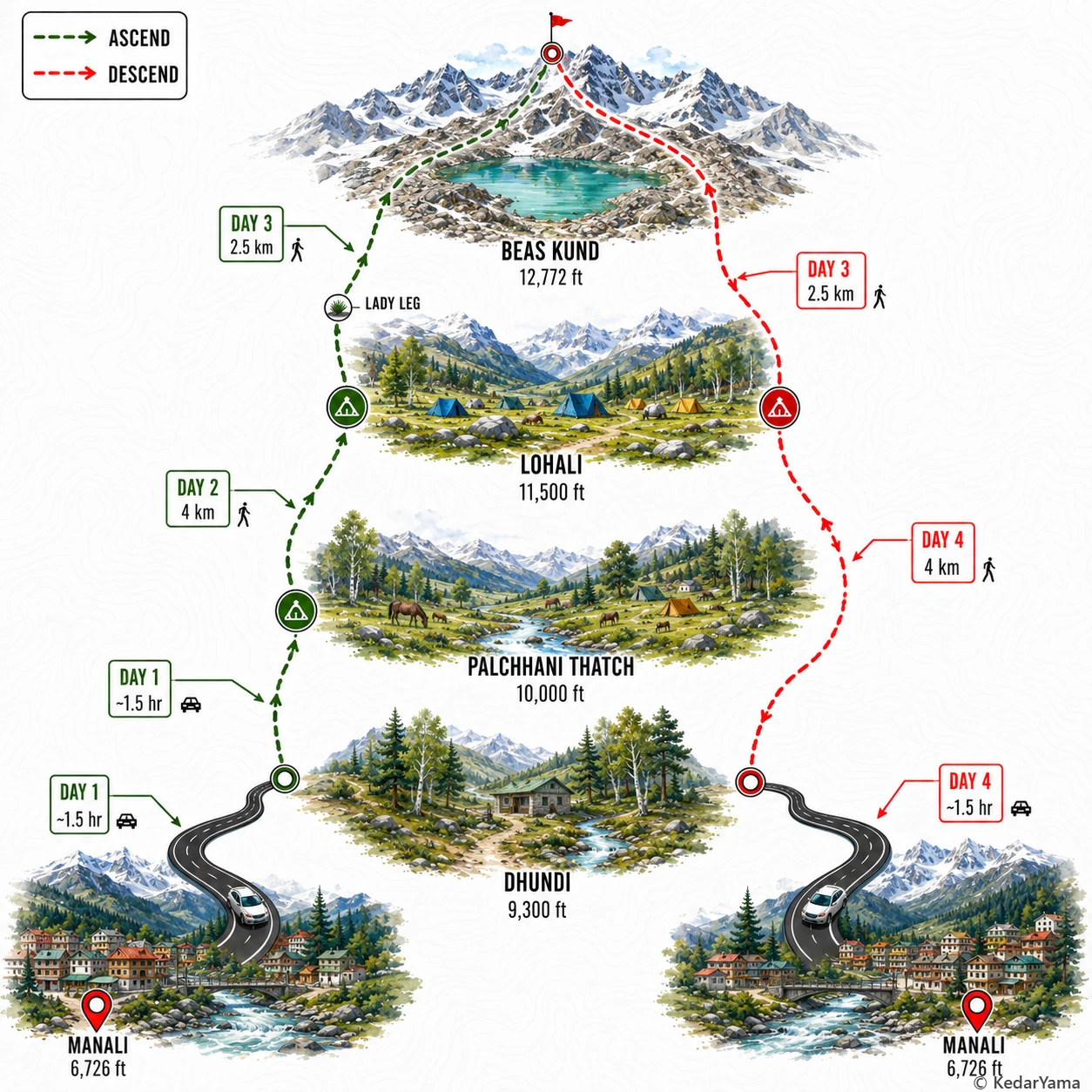
Trek Route

Graphical route map — high resolution terrain visualization

Detailed Itinerary

campingStayTent
signal_cellular_altDataPartial
power_offPowerNot available
  • Meet in Manali around 8:00 AM, drive for about 1.5 hours through Solang Valley to Dhundi, complete the final gear check and begin trekking by late morning.
  • The first day's walk is short—about 1.5 km in roughly an hour—following the lively Beas River through broad meadows with pine, birch and walnut trees scattered along the valley.
  • Snow-covered peaks like Hanuman Tibba and Friendship Peak begin appearing ahead while grazing horses and shepherd camps add life to the landscape.
  • Reach Palchhani Thatch by early afternoon, enjoy a hot lunch, spend the evening acclimatizing around the campsite and watch the surrounding mountains glow during sunset.

Packing List

Must Have

Trekking Boots

layers

3-Layer Clothes

backpack

50L Backpack

water_drop

Hydration

timeline

Trekking Pole

ac_unit

Down Jacket

back_hand

Gloves

Woolen Socks

Woolen Socks

lightbulb

Headlamp

thermostat

Thermal Layers

medical_services

First Aid Kit

Good to Have

battery_charging_full

Power Bank

checkroom

Quick-dry Towel

photo_camera

Action Cam

water_full

Hydration Bladder

front_hand

Winter Gloves

directions_walk

Trek Gaiters

Technical Overview

terrain

Trail & Terrain

The trek starts on gentle shepherd trails before entering a broad glacial valley beside the Beas River. Expect grassy meadows, loose moraine, boulder fields and several stream crossings as you gain altitude. The final climb towards Lady Leg and Beas Kund is the steepest section, where large rocks and snow patches may remain until early summer. The trail is well-defined but can become confusing in fog or fresh snow.

info

Altitude & Acclimatization

Although the trek is short, you climb from around 9,300 ft to nearly 12,800 ft in only a few days. Most trekkers acclimatize well because of the gradual camps, but headaches and mild AMS symptoms are still possible. Stay hydrated, walk at a steady pace and avoid racing uphill on the summit day. Report any persistent headache, nausea or dizziness immediately.

ac_unit

Weather

Days are pleasantly cool during May, June, September and October, while mornings and nights are cold at camp. Afternoon clouds are common, and brief rain or snowfall can develop even during otherwise clear weather. Strong winds are frequent above the tree line, especially near Lady Leg and Beas Kund. Carry warm layers and reliable rain protection regardless of the forecast.

info

Water Sources

The Beas River and several glacial streams accompany much of the route, but water availability becomes limited on the upper sections beyond Lohali. Fill bottles before leaving camp on summit day because there are few dependable refill points near Beas Kund. Water should always be filtered, purified or boiled before drinking.

info

Landscape & Wildlife

Lower sections feature pine, birch and walnut trees before opening into expansive alpine meadows. During late spring and early summer the valley is covered with colorful Himalayan wildflowers and medicinal herbs. If you're fortunate, you may spot Himalayan monal, marmots, mountain sheep or soaring lammergeiers against the dramatic backdrop of Hanuman Tibba, Friendship Peak and Shitidhar.

When to Visit

calendar_today

Snow patches and green meadows

May – June

This is the most popular season for the Beas Kund Trek. You'll find lingering snow near the lake, blooming alpine meadows, comfortable daytime temperatures, and excellent mountain views.

calendar_today

Lush landscapes with frequent rain

July – August

The valley turns intensely green and wildflowers appear across the meadows. Rain, slippery trails, and frequent cloud cover can reduce visibility, so weather flexibility is important.

calendar_today

Crystal-clear Himalayan views

September – October

Autumn brings dry weather, crisp air, and some of the clearest views of Friendship Peak, Hanuman Tibba, and Shitidhar. Nights become colder, but trekking conditions are generally excellent.

Other Information

Logistics & inclusions

  • check_circleReach Manali a day before the trek for a relaxed start and gear check.
  • check_circleMost operators arrange a shared morning drive from Manali to Dhundi via Solang Valley.
  • check_circleExtra luggage can usually be left in Manali or at the operator's storage facility.
  • check_circleCamping equipment, meals and common safety gear are generally included in organized treks.
  • check_circlePrivate vehicles are generally not allowed beyond designated points near Solang; operator transport is commonly used.

Permits

Required: Yes

Forest entry permission is required for the Beas Kund route and is usually arranged by registered trek operators. Carry a government-issued photo ID. Independent trekkers should obtain applicable forest permissions locally before starting.

Safety

Risks

  • Acute Mountain Sickness due to rapid altitude gain
  • Loose rocks and slippery moraine near Beas Kund
  • Sudden rain, snowfall and poor visibility
  • Fast-flowing glacial streams
  • Cold winds and sub-zero night temperatures

Precautions

  • Maintain a slow, steady pace and stay well hydrated.
  • Carry proper trekking shoes with good grip and warm layers.
  • Start summit day early to avoid afternoon weather changes.
  • Never attempt stream crossings without guide instructions.
  • Do not trek alone in fog or after dark.

Emergency

The nearest major medical facilities are in Manali. Mobile connectivity is unreliable beyond Solang Valley, and rescue operations depend on weather conditions. Trek leaders typically carry first-aid kits and emergency oxygen.

Reviews

Frequently Asked Questions

Is the Beas Kund Trek suitable for beginners?expand_more
What is the best time to do the Beas Kund Trek?expand_more
How do I reach the Beas Kund Trek starting point from Delhi?expand_more
Can I see snow on the Beas Kund Trek?expand_more
Do I need a permit for the Beas Kund Trek?expand_more
How difficult is the Beas Kund Trek compared with Triund?expand_more
How cold does it get during the Beas Kund Trek?expand_more